This article explores how burnout develops, why it’s so often misunderstood, and what really sits beneath the exhaustion, frustration, and sense of being stuck. By looking at the workplace cultures and pressures that fuel it, we can begin to understand burnout not as a personal failure, but as a response to environments that don’t support human wellbeing.
Article Key Takeaways
- Burnout is widespread and often shows up as exhaustion, hopelessness, and feeling stuck.
- It’s driven by workplace culture, not just difficult people or isolated incidents.
- Chronic, unmanaged stress — as recognised by the WHO — is at the core of burnout.
- Poor communication and feeling unheard deepen confusion, frustration, and emotional strain.
- High‑pressure, results‑only environments leave little room for learning, support, or recovery.
- Lack of trust and connection in teams increases isolation and anxiety.
- Micromanagement and inconsistent policies erode confidence and contribute to long‑term stress.
Workplace Burnout: Its More Common
I’m increasingly finding myself working with people whose experiences range from workplace stress to complete burnout — some moving beyond discomfort into hopelessness, despair, and a sense of desperation at work.
"Just leave then... " They say. "Find another job..."
Where once the decision felt binary — stay or go — it’s now far more complex. Contributing factors include rising financial precarity and the reality of carrying more responsibilities than ever: caring for children, ageing parents, managing health conditions, and supporting partners who are struggling. There’s also the fact that our work identity forms a significant part of who we are nowadays.
Trying to stay fair, every workplace I’ve been part of has had its quirks — enough to make it feel less than desirable at times. But I’ve realised the real issue is rarely one person or one behaviour. It’s the culture as a whole — the system people are working inside — that shapes how those quirks show up and how well different personalities fit (or don’t fit) within it.
There’s always someone like Tina, projecting across the office with a voice that could shake the ceiling tiles, and someone like Jaden, swaggering up and down the corridor retelling the same stories everyone knows by heart(🙄). These personalities can be annoying, yes, but they’re also what make a workplace feel unique. Diversity is a blessing.
These kinds of workplace dynamics may contribute to exhaustion, but they’re rarely the sole cause of burnout. They tend not to be the primary catalysts for complete burnout; rather, they sit alongside deeper pressures that accumulate over time if not addressed.

What Is Workplace Burnout ?
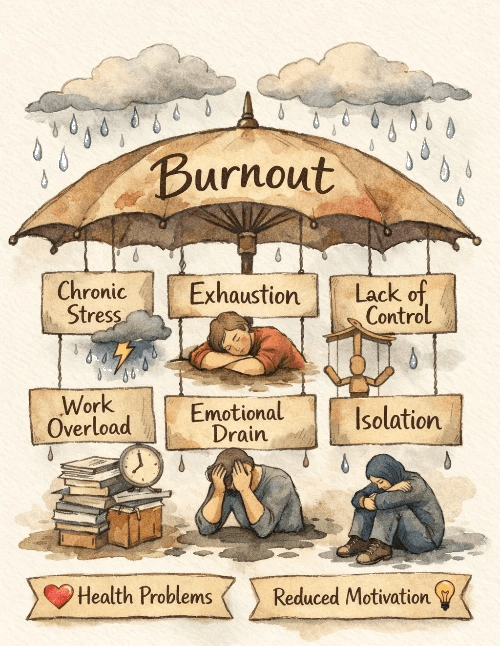
Let’s look at burnout in its unsaturated, purest form. The AI‑generated image (above) captures some of the experiences that burnout can involve. Burnout isn’t a single feeling, but a cluster of interconnected experiences. As (WHO, 2019) notes in the 11th Revision of the International Classification of Diseases (ICD‑11), burnout is not classified as a medical condition, but rather as an "occupational phenomenon"
“a syndrome conceptualized as resulting from chronic workplace stress that has not been successfully managed." (WHO,2019)
It then goes into catagorising into 3 main dimensions:
- Experiencing energy depletion and/or exhaustion
- Increased mental distance from aspects relating to work, or feelings of negativism or cynicism
- Reduced professional efficiency.
The following however are some of the likley causes that people have purported, when working with individuals. They are also some of my own that I have expereinced first hand, which I have tried to provide some examples.
1) You Feel Like You're Speaking Different Languages
The issue often arises when individuals bring concerns to someone higher up — typically a manager — where a natural hierarchy creates an imbalance of power. In these interactions, people frequently feel unheard or dismissed. This lack of genuine listening becomes the starting point of the problem, and over time communication deteriorates, causing further issues of concern.
Instead of listening to understand, many people may listen only so they can respond. Because of this, someone may share something important and receive a reply that barely connects to what they actually said — almost as if the other person is speaking a different language. Their reactions can feel robotic or scripted, as though they’re not responding to this moment but to some previous interaction that only vaguely resembles the current one. The result is a mismatch: the reply doesn’t fit, parts of it feel irrelevant, and the conversation becomes confusing as though both parties are having a completly different conversation to one another.
For example, a coworker might be triggered by something you’ve done, but instead of responding to the present situation, they begin running an old internal script — a memory of a past event with someone else. Their reaction becomes shaped by that old experience rather than what is happening now. They say things that don’t quite make sense because they’re not really talking to you; they’re talking to someone from their past through you. A similar situation that possibly remains unresolved for them. It can be unsettling, because it feels as though you’re speaking not to the person themselves but to an outer shell on autopilot, an eyes glazed over effect.
People often struggle to articulate this experience because it isn’t overt abuse or neglect. Instead, it’s a subtle, almost invisible dynamic that leaves them feeling disoriented. It may indicate that the person responding in this way is unequipped to handle the situation and automatically reverts to the nearest familiar script, or that they are under stress and rush to fill the space with a quick, mismatched response.
Either way, it can signal dismissal or a lack of acknowledgement. Over time, this creates further complications: misunderstandings deepen, communication breaks down, and the relationship becomes increasingly strained.
2) It's All About Results Rather Than The Actual Process
It seems essential for companies to focus on results, which then become statistics. Those statistics turn into opportunities for funding and revenue. However, there is often a fixation on the destination rather than the actual process that leads up to it. When the destination becomes over‑emphasised, the process becomes under‑attended — yet without a healthy, sustainable process, the destination simply cannot and will not exist (properly!).

For example, I once worked in a finance department where meeting strict deadlines for processing accounts was considered absolutely essential! That’s true in many workplaces — but what stood out was the lack of support behind those expectations. There was minimal training, no ongoing guidance, and no time set aside during work hours to learn the concepts we were expected to use. Little consideration was given when results weren’t achieved, even when the reasons were entirely understandable and reaslistic.
There seemed to be a false assumption that everyone already possessed the knowledge required to perform the role. If someone didn’t naturally grasp something, judgement quickly followed. People were ranked, compared, and labelled — who was “good” at their job and who wasn’t, who was “intelligent” and who was “not dedicated enough.”
Comments like, “Well, Bob can do it, and he’s had the same support as you,” were quite common.
...Good for bob (👏)
Sarcasm aside, the core issue came down to a lack of knowledge within the department about how to — I say this with candour — actually manage and grow a department from a place of process rather than destination. There was an even greater lack of understanding about the process of learning and development.
Processes were heavily downsized, and as a result the culture became fixated on results rather than the process required to achieve them. The department continued to operate under the assumption that they had enough fuel to keep the fire going each day, pushing staff harder and harder, setting unrealistic expectations, and failing to hear or understand what people desperately needed in order to do their jobs well: time, training, and development.
No matter how many times this was raised, everything came back to statistics. The department has been in a gradual decline, and many of the new recruits left within weeks of joining.
3) Lack Of Trust Between Colleagues: A Social Recession
Bad work cultures breed toxicity within groups and erode the trust and connection that would normally form naturally. People become fearful of helping or protecting anyone but themselves. It creates something close to a divide‑and‑conquer dynamic: when everyone is isolated, worried about being betrayed, or anxious that something they say might be reported, the safest option becomes saying nothing at all.
This is part of why whistleblowing policies are so controversial. Although they give people the right and autonomy to report abuse or harassment, they still rely on an individual’s interpretation of how serious the issue is and how far they are willing to take it. That uncertainty leads to a culture where people trust nobody, and communication shuts down. It becomes a kind of social recession — silence replaces dialogue, and fear replaces connection.
When communication stops flowing, toxicity increases. Over time, this environment fuels extreme levels of burnout, emotional exhaustion, and a deep sense of isolation.
4) You Are Being Micromanaged

Micromanaging is when a manager checks in constantly about every small task — telling people what to do, when to do it, and offering performance feedback at every possible moment. There is no balance. It’s a style rooted in underlying anxiety and panic, masked as assertiveness or leadership. Whether the manager realises it or not, it becomes a control strategy. Their anxiety is passed directly onto staff, who begin to second‑guess themselves, feel on edge, and fear consequences at every turn.
One person I worked with described the sheer panic they felt going to work, knowing their boss could call at any moment, tear apart their work, and add even more tasks to the day’s list.
A management style is shaped by many factors — training, corporate upbringing, personal beliefs about leadership, and pressure from above. But regardless of these influences, there is always an opportunity to give people space, trust them, and allow them to do their work. Flooding a team with anxiety — which is the inevitable outcome of micromanagement — is not leadership.
Managers often expect staff to suppress their feelings and “just get on with it.” Instead, people start masking, hiding the truth out of fear, and this directly and indirectly affects performance. Struggling under micromanagement is not a sign of weakness. The real weakness lies in failing to recognise that actions have consequences, and that teams are made up of humans, not robots.
In reality, some of the best staff are often the most emotionally intelligent and attuned — and with that comes the awareness that every action has an equal and opposite reaction, whether it’s visible or not.
5) Policy & Double Standards In the Workplace

Policy is designed to protect the interests of everyone it covers. It sets out, in black and white, the standards and expectations for the organisation, helping ensure that people receive a consistent and high‑quality service. But although we like to imagine policies as straightforward and objective, the reality is far more complex.
In large organisations with multiple departments, moving parts, and layers of staff, policies are rarely tailored to the specific context. They have to apply to everyone, which means they are written in broad, generic terms. This leaves them open to interpretation by the people enforcing them — and that interpretation can put individuals at risk by the very policies meant to protect them.
A light‑hearted example: someone realises they’re out of tea, so they take a teabag from the communal cupboard. Technically, “theft of any kind” is prohibited. Suddenly, they’re called into a meeting, accused of theft, and disciplined. The definition of “theft” becomes stretched to fit the situation, and the response becomes disproportionate.
Anything can be interpreted as anything if someone wants it to be. Policies can be used to make someone’s life extremely difficult because almost any behaviour can be made to match a breach of policy if the interpreter is motivated enough — often without considering context, intent, or common sense. This is dangerous. People have been disciplined or even dismissed based solely on one manager’s interpretation, sometimes influenced by personal bias rather than genuine misconduct.
Conversely, managers can choose to acknowledge the policy but apply discretion, recognising the grey areas. Or they can escalate the matter, sending their interpretation to a decision‑making team who often have even less understanding of what actually happened, and whose priority is to protect the organisation. It becomes the ultimate misuse of power.
A former friend of mine was once brought into a meeting — with a note‑taking manager present — because she didn’t ask a colleague whether they wanted anything from Greggs during the morning breakfast run. The colleague complained, it was logged under the complaints policy, and she received a formal warning. No malice, no exclusion, no intent — just a missed question about some bacon.
As amusing as it sounded at the time, the incident highlighted something serious: once a complaint is made under policy, it must be investigated, no matter how trivial. And when the grey areas are ignored, the consequences can feel absurd. That warning devalued every other action taken afterwards, especially when compared to genuinely serious matters. It showed how essential common sense is when interpreting policy — and how damaging it can be when it’s absent.
6) The Goalposts (Expectations) Keep Changing

This is something that happens often: responsibility gets twisted and pushed onto people who had no power to influence the outcome. The solution needed to come from someone higher up, yet the blame falls on those with the least control.
Organisations set targets, and staff work hard to meet them. But even when those targets are achieved, they’re told in meetings that their performance “isn’t good enough” and needs to improve. A week later, priorities shift again, and performance drops — not because staff aren’t trying, but because the goalposts keep moving. When results inevitably fall short, the blame lands on the people who didn’t set the expectations and had no say in how to achieve them. It always falls on those who didn’t create the rules.
For example, in my younger years I worked at a well‑known pizza restaurant where we were expected to sell “by any means necessary” while also providing a warm, personal experience. I still don’t understand how we were meant to pressure customers into buying more while simultaneously offering hospitality. When the quarterly numbers came in, we were blamed for not doing enough — including not attracting enough customers into the building, as though that was somehow within our control.
It felt like we had missed the part of training where we were supposed to drag people in off the street, hold them hostage, take their money, and smile while doing it.
The expectations were unrealistic and disconnected from the resources we had. Yes, the business was losing money, but my role was simply to serve the customers who came in — customers brought in by strategies designed by people far above my pay grade. I was just the final step in a long chain. Why exactly was that my fault?
7) You Give Constant Feedback: They Listen But Nothing Happens

Feedback loops occur when individuals or teams identify an issue, gather information, and propose a practical solution. Ideally, this process benefits the organisation through increased efficiency, improved job satisfaction, and updated processes informed by the real‑world experience of staff.
Staff bring their findings to managers — in one‑to‑one meetings or group discussions — with the expectation that their insights matter. While their concerns may be acknowledged, people rarely feel that their frustrations lead to meaningful change, even after raising the same issues repeatedly.
In one debt management department, staff were required to begin every call with: “Are you wanting to pay in full today?” There was no logical reason for this. It irritated callers who were voluntarily seeking support with payment plans or time‑to‑pay arrangements; many became frustrated or simply hung up.
Staff raised this issue repeatedly over several years, confident that the scripted line contributed to low recovery rates. Nothing changed. Instead, staff were blamed for not meeting targets, despite knowing exactly why those targets were unrealistic — and why callers were becoming less willing to engage with the very people trying to support them.
The department had one of the highest turnover rates in the organisation, yet no strategy was implemented to address the processes, structure, or culture — even though the root issue was well known.
When people don’t feel heard, especially when their feedback is grounded in experience and evidence, more is required than simply stating that “everyone’s opinion matters.” What matters is what happens after the feedback is given. When staff find themselves stuck in endless loops, trying to improve the workplace while leadership remains reluctant to change, they are left feeling unheard, working within systems that are no longer fit for purpose, and navigating a culture that shrugs and says, “This is just how things are.”
Being unheard leads to burnout and exhaustion — and eventually, large‑scale sickness absence.
Conclusion
Terms like emotional fatigue and burnout are becoming far more common — and this is not a coincidence. When I first began counselling, these words were familiar within the mental‑health world, but they weren’t widely used outside of it. Increased awareness through social media for instance has made these concepts more accessible, giving people language for experiences they previously couldn’t name.
When it comes to companies and workplaces, this raises an important question: where is the line drawn? In a future post, I’ll share an encounter I had with AI about how corporations function and the people within them. I’m drawn to AI for this very reason — it offers a perspective on the wider system.
For now, let’s acknowledge something simple but often unspoken: the things happening at work that feel difficult to explain — the behaviours you sense but can’t quite pin down because they’re subtle or covert — are real. You’re not imagining them, and you’re not the only one experiencing them. These patterns show up across countless workplaces, in both the private and public sector. Many people are navigating the same under‑the‑surface dynamics, even if they rarely get spoken about openly. So you're not alone.
References:
1) World Health Organization (2019) Burn-out an “occupational phenomenon”: International Classification of Diseases. Available at: https://www.who.int/news/item/28-05-2019-burn-out-an-occupational-phenomenon-international-classification-of-diseases (Accessed: 23 May 2026)

Author - Benjamin Wright
Counsellor | Counselling Supervisor