thumbnail image
A logo design featuring a circular arrangement of overlapping purple arcs, forming a dynamic, layered ring. Near the top center of the circle are three small purple dots aligned horizontally, adding visual balance. Inside the circle, the word “WRIGHT” is prominently displayed in bold, uppercase black letters. Beneath it, the phrase “COUNSELING & SUPERVISION SERVICE” appears in smaller, uppercase purple text. The overall design conveys a modern and professional identity, with the circular motif suggesting wholeness, connection, and continuity—well-suited to a therapeutic or supervisory context

  • Home
  • Services 
    • Therapeutic Counselling
    • Online Counselling
    • Counselling Supervision
    • Encounter Group Supervision
    • Client & Supervisee Portal
  • About 
    • About Me
    • The Counselling I Provide
    • The Supervision I Provide
    • My Training & Experience
  • Testimonials
  • WCSS Info 
    • Contact Information
    • Service Information & Pricing
    • Business & Owner Statement
    • Practice Policies
  • Wrightings Blog
  • Shop 
    • Products
    • All‑in‑One Practice System
  • …  
    • Home
    • Services 
      • Therapeutic Counselling
      • Online Counselling
      • Counselling Supervision
      • Encounter Group Supervision
      • Client & Supervisee Portal
    • About 
      • About Me
      • The Counselling I Provide
      • The Supervision I Provide
      • My Training & Experience
    • Testimonials
    • WCSS Info 
      • Contact Information
      • Service Information & Pricing
      • Business & Owner Statement
      • Practice Policies
    • Wrightings Blog
    • Shop 
      • Products
      • All‑in‑One Practice System
Log In
A circular green button featuring a white power symbol at its center. The symbol consists of a vertical line intersecting the top of a broken circle—an internationally recognized icon for powering on or off electronic devices. The background is a gradient of dark purple, which contrasts sharply with the bright green button, making it visually prominent. The design is sleek and modern, evoking themes of activation, control, and digital readiness. It may represent user interface elements, tech branding, or symbolic prompts for engagement and decision-making
A logo design featuring a circular arrangement of overlapping purple arcs, forming a dynamic, layered ring. Near the top center of the circle are three small purple dots aligned horizontally, adding visual balance. Inside the circle, the word “WRIGHT” is prominently displayed in bold, uppercase black letters. Beneath it, the phrase “COUNSELING & SUPERVISION SERVICE” appears in smaller, uppercase purple text. The overall design conveys a modern and professional identity, with the circular motif suggesting wholeness, connection, and continuity—well-suited to a therapeutic or supervisory context

  • Home
  • Services 
    • Therapeutic Counselling
    • Online Counselling
    • Counselling Supervision
    • Encounter Group Supervision
    • Client & Supervisee Portal
  • About 
    • About Me
    • The Counselling I Provide
    • The Supervision I Provide
    • My Training & Experience
  • Testimonials
  • WCSS Info 
    • Contact Information
    • Service Information & Pricing
    • Business & Owner Statement
    • Practice Policies
  • Wrightings Blog
  • Shop 
    • Products
    • All‑in‑One Practice System
  • …  
    • Home
    • Services 
      • Therapeutic Counselling
      • Online Counselling
      • Counselling Supervision
      • Encounter Group Supervision
      • Client & Supervisee Portal
    • About 
      • About Me
      • The Counselling I Provide
      • The Supervision I Provide
      • My Training & Experience
    • Testimonials
    • WCSS Info 
      • Contact Information
      • Service Information & Pricing
      • Business & Owner Statement
      • Practice Policies
    • Wrightings Blog
    • Shop 
      • Products
      • All‑in‑One Practice System
Log In
A circular green button featuring a white power symbol at its center. The symbol consists of a vertical line intersecting the top of a broken circle—an internationally recognized icon for powering on or off electronic devices. The background is a gradient of dark purple, which contrasts sharply with the bright green button, making it visually prominent. The design is sleek and modern, evoking themes of activation, control, and digital readiness. It may represent user interface elements, tech branding, or symbolic prompts for engagement and decision-making
A logo design featuring a circular arrangement of overlapping purple arcs, forming a dynamic, layered ring. Near the top center of the circle are three small purple dots aligned horizontally, adding visual balance. Inside the circle, the word “WRIGHT” is prominently displayed in bold, uppercase black letters. Beneath it, the phrase “COUNSELING & SUPERVISION SERVICE” appears in smaller, uppercase purple text. The overall design conveys a modern and professional identity, with the circular motif suggesting wholeness, connection, and continuity—well-suited to a therapeutic or supervisory context
  • Individual Counselling

    Face to Face & Online Therapeutic Counselling Services

  • Welcome To Counselling

    Listen To Page
  • A single dark green wooden chair stands centered in a minimalist setting. The chair features a flat rectangular seat, four straight legs, and a slightly curved backrest composed of vertical slats. It is positioned on a smooth, light-colored floor that reflects soft shadows beneath and around the chair. The background is a neutral gradient, fading from light beige at the base to a soft gray toward the top, creating a calm and contemplative atmosphere. The lighting is gentle and directional, emphasizing the chair’s texture and form without harsh contrasts. The composition evokes themes of solitude, simplicity, and design focus, with the chair as the sole subject in an otherwise empty space.
    A casually dressed person sits alone on a wooden fence at a scenic overlook, gazing out over a sprawling cityscape below. The individual wears a striped shirt, jeans, and sneakers, with a dark jacket tied around their waist. A water bottle rests on the ground nearby, suggesting a pause during a walk or hike. The viewpoint is elevated—likely a hill or mountain—offering a panoramic view of densely packed urban buildings stretching toward the horizon. The sky above is hazy, casting a soft, muted light over the scene. The composition conveys a quiet moment of reflection and solitude, with the contrast between the natural foreground and the vast, structured city below evoking themes of contemplation, escape, and connection between nature and urban life
    Corner view of a multi-story building featuring a bold neon sign that reads “TIME IS PRECIOUS” in glowing white letters. The sign is mounted on a white-painted section of the facade, contrasting with the adjacent brown brickwork and rows of windows. The building’s architectural mix of textures—brick, paint, glass—adds urban character, while the illuminated message stands out as a philosophical prompt or public reminder. The composition captures a moment of stillness and reflection in the city, suggesting themes of urgency, mindfulness, and the value of presence amid everyday routines.
    A person holds an open notebook filled with dense handwritten notes and diagrams, likely mathematical or scientific, rendered in blue ink. The pages feature symbols, equations, and grid-like structures resembling matrices or tables, suggesting focused study or problem-solving. The notebook is framed against a tranquil outdoor backdrop: a grassy field stretches toward a line of trees, with a body of water visible in the distance beneath a partly cloudy sky. The juxtaposition of rigorous intellectual work and serene natural surroundings evokes themes of contemplation, balance, and the integration of knowledge with lived experience.
    A person with wavy dark hair, dressed in a mustard-colored top, gazes into a large ornate mirror with a distressed white frame. They rest their face gently in both hands and smile warmly at their reflection, capturing a moment of candid joy and self-connection. The softly lit room behind them features white walls and a window that casts natural light across the scene, adding a sense of calm and intimacy. The composition emphasizes themes of self-acceptance, inner peace, and the quiet beauty of personal reflection.

    An Introduction To Counselling

    What Is Counselling?

    When Is The Right Time?

    Areas Counselling Works With

    Benefits

    A person sits casually on a beige and brown leather couch placed incongruously in the middle of a quiet residential street. They wear a hooded winter jacket and brown trousers, with legs stretched out and feet resting on a glass coffee table positioned in front of the couch. The scene is bathed in the warm light of a setting sun, casting elongated shadows across the pavement. Surrounding the street are leafless trees, power lines, and suburban houses, all subtly illuminated by the golden hour glow. The juxtaposition of indoor furniture in an outdoor public space creates a surreal, contemplative atmosphere—blending domestic comfort with urban exposure. The image evokes themes of displacement, introspection, and the blending of private and public realms.
    A modern living room is styled with warm, neutral tones and cozy furnishings, yet features an unexpected architectural element—a large, industrial vault door embedded in the wall. The room includes a beige upholstered sofa, a gray armchair, and a wooden coffee table topped with a small potted plant. A floor lamp stands beside the sofa, casting soft ambient light, while a wooden bookshelf filled with books and decorative items adds texture and personality to the space. The vault door is metallic, circular, and imposing, with visible bolts and a central locking mechanism, sharply contrasting with the domestic comfort of the room. Its presence introduces a surreal or symbolic layer, suggesting themes of hidden value, protection, or psychological depth within a home environment. The overall composition blends security and serenity, creating a visually arresting and thought-provoking interior
    A large green flag billows dramatically in the wind against a pale, overcast sky. In the foreground, a solitary figure walks across the scene, silhouetted in dark tones and partially obscured by the flag’s movement. The flag dominates the composition, its vibrant green fabric rippling with energy and scale, while the person appears small and contemplative by contrast. The interplay of motion and stillness, color and shadow, evokes themes of identity, resilience, and presence within larger forces. The image suggests a moment of quiet defiance or reflection, framed by the symbolic weight of the flag and the expansive sky.
    A close-up portrait of a person with curly hair set against a solid blue background. The individual’s face is partially obscured on the left side by a large leaf featuring a vivid green and white vein pattern, adding an organic, textural contrast. The person wears bold, colorful eye makeup—green and red tones blended across the eyelids—creating a striking visual focal point. Their skin is shown with natural texture, including visible pores and blemishes, emphasizing authenticity and realism. The composition balances vibrant color, natural imperfection, and botanical elements, evoking themes of identity, self-expression, and the interplay between human and nature
       A nighttime outdoor portrait featuring a person standing in front of lush green foliage illuminated by warm string lights. The individual wears a dark outfit and poses with one hand gently resting on the opposite shoulder, creating a contemplative or self-embracing gesture. The soft glow of the lights casts a golden hue across the leaves, adding depth and warmth to the scene. The interplay of light and shadow evokes a serene, introspective atmosphere, with the person partially silhouetted against the festive backdrop. The image suggests quiet celebration, personal reflection, or emotional grounding in nature.

    Myths & Realities of Counselling

    Confidentiality

    Counsellor Do's & Donts's

    Goals

    New To Counselling?

    A circular green button featuring a white power symbol at its center. The symbol consists of a vertical line intersecting the top of a broken circle—an internationally recognized icon for powering on or off electronic devices. The background is a gradient of dark purple, which contrasts sharply with the bright green button, making it visually prominent. The design is sleek and modern, evoking themes of activation, control, and digital readiness. It may represent user interface elements, tech branding, or symbolic prompts for engagement and decision-making
  • An Introduction To Counselling

    A single dark green wooden chair stands centered in a minimalist setting. The chair features a flat rectangular seat, four straight legs, and a slightly curved backrest composed of vertical slats. It is positioned on a smooth, light-colored floor that reflects soft shadows beneath and around the chair. The background is a neutral gradient, fading from light beige at the base to a soft gray toward the top, creating a calm and contemplative atmosphere. The lighting is gentle and directional, emphasizing the chair’s texture and form without harsh contrasts. The composition evokes themes of solitude, simplicity, and design focus, with the chair as the sole subject in an otherwise empty space.

    Lets Get Started

    Let’s dive straight into what might be useful to know. Some readers may have had prior counselling experience, while others might be newcomers starting out on their journey.

    It would be great to hear from you with any questions you may have. The contact form is located towards the bottom of the page, and an audio recording of this page is available — click the “Soundload” button at the top to download the secure file onto any device.

    The counselling profession offers a diverse range of styles and approaches, each shaped by the unique personal style and healing philosophy that counsellors bring to their work. Because of this, it’s difficult to pinpoint one universal definition.

    However, we can attempt to define counselling by taking inspiration from what most approaches have in common. I propose we start by generally exploring what counselling is, and then look more closely at one specific approach.

    Return to Contents
  • What is Counselling?

    A casually dressed person sits alone on a wooden fence at a scenic overlook, gazing out over a sprawling cityscape below. The individual wears a striped shirt, jeans, and sneakers, with a dark jacket tied around their waist. A water bottle rests on the ground nearby, suggesting a pause during a walk or hike. The viewpoint is elevated—likely a hill or mountain—offering a panoramic view of densely packed urban buildings stretching toward the horizon. The sky above is hazy, casting a soft, muted light over the scene. The composition conveys a quiet moment of reflection and solitude, with the contrast between the natural foreground and the vast, structured city below evoking themes of contemplation, escape, and connection between nature and urban life

    A General Definition of Counselling

    So firstly, here’s a general definition of counselling, based on some of my own experiences. My role is to meet with individuals, usually once a week, in a confidential setting, to actively listen and deeply connect with the thoughts, feelings, and experiences that are openly shared within the counselling space.

    My aim is to offer complete, undivided attention and to help individuals work through barriers or blocks that may be hindering growth and development. Counselling provides a safe, reflective environment where change can begin through understanding and connection.

    I believe this is a fair and accurate assessment of what counselling is at its core, regardless of the approach. Moving forward, let’s look at one specific approach to counselling — the one I use most often — as it allows me to offer a deeper level of understanding based on working knowledge and experience.

    About The Person Centred Counselling Approach

    I’m known as a Person‑Centred therapeutic counsellor. Person‑Centred counselling is a humanistic approach that focuses on relationships and the significance they hold in our lives. The word relationship is broad — it describes the many forms of relational contact we have with others, such as family, partners, and friendships. It can even refer to the relationship we have with ourselves.

    Person‑Centred counselling is designed to be flexible and adaptive to meet the needs of each individual. From the first contact, respect, authenticity, and non‑judgement are freely given. There is a commitment to nurturing what are known as psychological conditions within the working relationship between client and counsellor — qualities that help individuals discover their own path to becoming self‑sufficient and autonomous.

    I believe that, on some level, the therapist is the therapy. This means the counsellor’s qualities and contributions to the relationship are among the main sources of healing for the client. The process is deeply relational, and growth often emerges through genuine human connection.

    I haven’t found a sacred magic wand or ultimate guide to “fixing” the parts of us that feel broken. However, Person‑Centred counselling offers the chance to build a strong, healthy connection in a safe environment. A well‑established dynamic between client and counsellor can — hopefully, fingers crossed — positively influence other areas of someone’s life beyond the therapy room.

    Whilst on the topic of human contact, it’s worth mentioning the work of journalist Johann Hari, author of Lost Connections. Hari highlights the importance of connection and its healing potential, even suggesting that depression may be alleviated through connection. In counselling, relief is often found through that same sense of connection.

    Personal Motivations of A Counsellor

    Counsellors are often motivated by deeply personal reasons. My About Me section touches briefly on my own experiences, but to expand — my motivation stems from a time when I encountered a lack of professional competency from those responsible for my care. Sadly, I wasn’t met with the genuineness, care, or quality of attention I had hoped to receive.

    Everything I didn’t experience then has become the foundation of my practice today — a commitment to offering authenticity, attentiveness, and genuine human connection. In many ways, it’s my way of showing how counselling can truly be done with integrity and compassion.

    For other counsellors and psychotherapists, motivations may differ but are no less meaningful. Even within a single approach, many personal styles emerge. Though similar in principle, each is shaped by the counsellor’s own history, values, and lived understanding of what it means to support another person.

    In summary, a counsellor will be with you on your journey to facilitate, not dictate. The Person-Centred approach is what I call real healing. Not robotic, not scripted. It's about connection and it is about being real.

    kill switch align

    Return to Contents
    A circular green button featuring a white power symbol at its center. The symbol consists of a vertical line intersecting the top of a broken circle—an internationally recognized icon for powering on or off electronic devices. The background is a gradient of dark purple, which contrasts sharply with the bright green button, making it visually prominent. The design is sleek and modern, evoking themes of activation, control, and digital readiness. It may represent user interface elements, tech branding, or symbolic prompts for engagement and decision-making
  • When The Right Time Might Be

    The Best Time To Have Counselling

    It can be helpful to explore when counselling might be most beneficial. Timing matters — accessing support at the right moment can make the experience more meaningful and effective.

    Part of this involves noticing the signs that your emotional or physical wellbeing may be shifting. Recognising these changes early can help you identify the type of support that might be most useful and when to reach out for it.

    Self -Awareness

    From the initial thought of needing support to the first step, counselling can be gradual process. Reaching out shouldn’t be rushed; it takes as long as it takes. Having awareness of the challenges in our lives is extremely important.

    According to the Cambridge Dictionary, awareness is defined as:

    “knowledge that something exists or understanding of a situation or subject at the present time
    on information or experience”

    We may have moments of awareness throughout the day. Sometimes thoughts that we acknowledge and let go of,
    allowing them to run their course. Other times, we can hold onto thoughts. When we start to hold onto too many of our thoughts for longer and longer periods, instead of allowing them to pass freely through us, the body starts storing and negatively impacting us.

    The body can respond to challenges emotionally, mentally and even physically. Here are just some of the ways that our bodies can do this:

    • Restlessness or agitation
    • sudden triggers of aggression, rage attacks, blackouts, or "seeing red"
    • Excessive use of painkillers
    • Dependence on substance
    • Persistent anxiety and/or panic attacks
    • Prolonged periods of sadness or low mood
    • Being overwhelmed with thoughts and emotion
    • Hearing voices that seem louder or more intrusive than usual
    • Difficulty concentrating or maintaining focus
    • Being sure of saying or seeing something, only to later realise they weren't real
    • Suicidal thoughts
    • Thoughts or the act of self- harm or engaging in self- harming behaviours
    • Struggling to engage in intimacy or connection in relationships
    • Consistent feelings of guilt and/or shame
    • Struggling to get out of bed
    • Difficulty waking up or falling asleep
    • Feeling disconnected from yourself or experiencing out-of-body sensations
    • Feeling afraid to leave home or go outside

    Social Influence on Mental Health

    Society is often where our understanding of counselling begins. Even before stepping into a therapy room, our perception of the process can be shaped by social media, television, and first‑hand accounts from people we know.

    Counselling holds different meanings and significance for everyone. The only way to build a deeper, more personal understanding is to experience the journey first‑hand. When the time feels right, the body often signals this to us — a quiet invitation to begin.

    Start by listening to your inner voice and allow it to guide you toward the right moment. The body will tell us what we truly need to hear if we sit with ourselves and allow space for it to come through.

    Return To Contents

    kill switch align

    A circular green button featuring a white power symbol at its center. The symbol consists of a vertical line intersecting the top of a broken circle—an internationally recognized icon for powering on or off electronic devices. The background is a gradient of dark purple, which contrasts sharply with the bright green button, making it visually prominent. The design is sleek and modern, evoking themes of activation, control, and digital readiness. It may represent user interface elements, tech branding, or symbolic prompts for engagement and decision-making
  • Some Areas Counselling Works With

    🧠 Mental Health Conditions

    Some conditions that counselling can help with include:

    • Anxiety Disorder
    • Depression
    • Agoraphobia
    • ADHD/ADD/AHD
    • Borderline Personality Disorder
    • Eating disorders
    • Post Traumatic Stress Disorder
    • Seasonal Affective Disorder (SAD)

    ⚖️ Trauma & Abuse

    These relate to experiences of violence, violation, or psychological trauma:

    • Domestic Abuse & Violence
    • Bullying & Harassment
    • Trauma Related Experiences

    💬 Relational & Social Issues

    These involve interpersonal dynamics or social challenges:

    • Relationship issues
    • Sexual relationships / encounters
    • Loneliness
    • Identity
    • Pregnancy
    • Internet & Technology Related Issues

    🧒 Young People & Education

    These are specific to developmental stages or school-related concerns:

    • Bullying
    • School attendance
    • Exam Stress

    🍃 Addiction & Behavioural Challenges

    These involve compulsive behaviours or substance use:

    • Drugs & Alcohol
    • Gambling
    • Rage
    • Workaholism
    • Addiction to Sex
    Return To Contents
  • Some of The Benefits

    A vibrant collage titled "Benefits Of Receiving Counselling" features six distinct sections arranged around a central yellow square with brown text. Each surrounding section highlights a specific benefit of counselling, using a combination of color, imagery, and concise text:  Top left (orange background): A photo of diverse hands joined in a circle symbolizes connection and support. The accompanying text reads "Stronger Friendships, Personal & Working Relationships," emphasizing interpersonal growth.  Top right (blue background): A smiling woman gazes at herself in a mirror, representing self-acceptance. The text "Improved Self Worth" suggests enhanced confidence and inner value.  Bottom left (green background): A cheerful woman in a checkered shirt stands outdoors, evoking openness and emotional clarity. The text reads "Increased Emotional Awareness & Agility."  Bottom right (purple background): A focused man works at a desk with a laptop and notebook, illustrating productivity. The text "Increased Focus & Concentration" highlights cognitive benefits.  Center (yellow background): The title "Benefits Of Receiving Counselling" anchors the collage, framed by the surrounding themes.  The overall design uses bold colors and relatable imagery to communicate the emotional, relational, and cognitive advantages of counselling in a clear, engaging format
  • Understanding The Myths & Realities

    Counselling comes in all shapes and sizes. It’s one of the most diverse professions in the world, which is incredible — because people have a choice in how they want their counselling to look and feel. However, there are some assumptions about counselling that seem to have come from many sources.

    A person sits casually on a beige and brown leather couch placed incongruously in the middle of a quiet residential street. They wear a hooded winter jacket and brown trousers, with legs stretched out and feet resting on a glass coffee table positioned in front of the couch. The scene is bathed in the warm light of a setting sun, casting elongated shadows across the pavement. Surrounding the street are leafless trees, power lines, and suburban houses, all subtly illuminated by the golden hour glow. The juxtaposition of indoor furniture in an outdoor public space creates a surreal, contemplative atmosphere—blending domestic comfort with urban exposure. The image evokes themes of displacement, introspection, and the blending of private and public realms.

    safe button align

    A circular green button featuring a white power symbol at its center. The symbol consists of a vertical line intersecting the top of a broken circle—an internationally recognized icon for powering on or off electronic devices. The background is a gradient of dark purple, which contrasts sharply with the bright green button, making it visually prominent. The design is sleek and modern, evoking themes of activation, control, and digital readiness. It may represent user interface elements, tech branding, or symbolic prompts for engagement and decision-making
  • 📚Common Counselling Myths

    Clients mostly lay back on a sofa to have therapy

    Counsellors Say ".. and how does that make you feel?" a lot

    Counsellors possess notepads and write as you talk

    Weak people need counselling

  • Return To Contents

    safe button Align

    A circular green button featuring a white power symbol at its center. The symbol consists of a vertical line intersecting the top of a broken circle—an internationally recognized icon for powering on or off electronic devices. The background is a gradient of dark purple, which contrasts sharply with the bright green button, making it visually prominent. The design is sleek and modern, evoking themes of activation, control, and digital readiness. It may represent user interface elements, tech branding, or symbolic prompts for engagement and decision-making

    Confidentiality

    Confidentiality is one of the most important components of counselling. It allows someone to feel safe enough to speak freely, without worrying or second‑guessing whether what they’ve said might reach someone else — or be used against them in any way.

    In counselling, confidentiality means that what is shared remains protected. Only under the most exceptional circumstances might a practitioner need to share something that has been spoken about. This is done solely to meet legal or ethical obligations, such as when there is immediate risk of harm.

    The practitioner has a duty to uphold this commitment for the sake of your trust and the relationship you build together. Nobody outside of that relationship should be privy to what’s shared. True confidentiality requires more than reassurance — it calls for a genuine, felt sense of trust
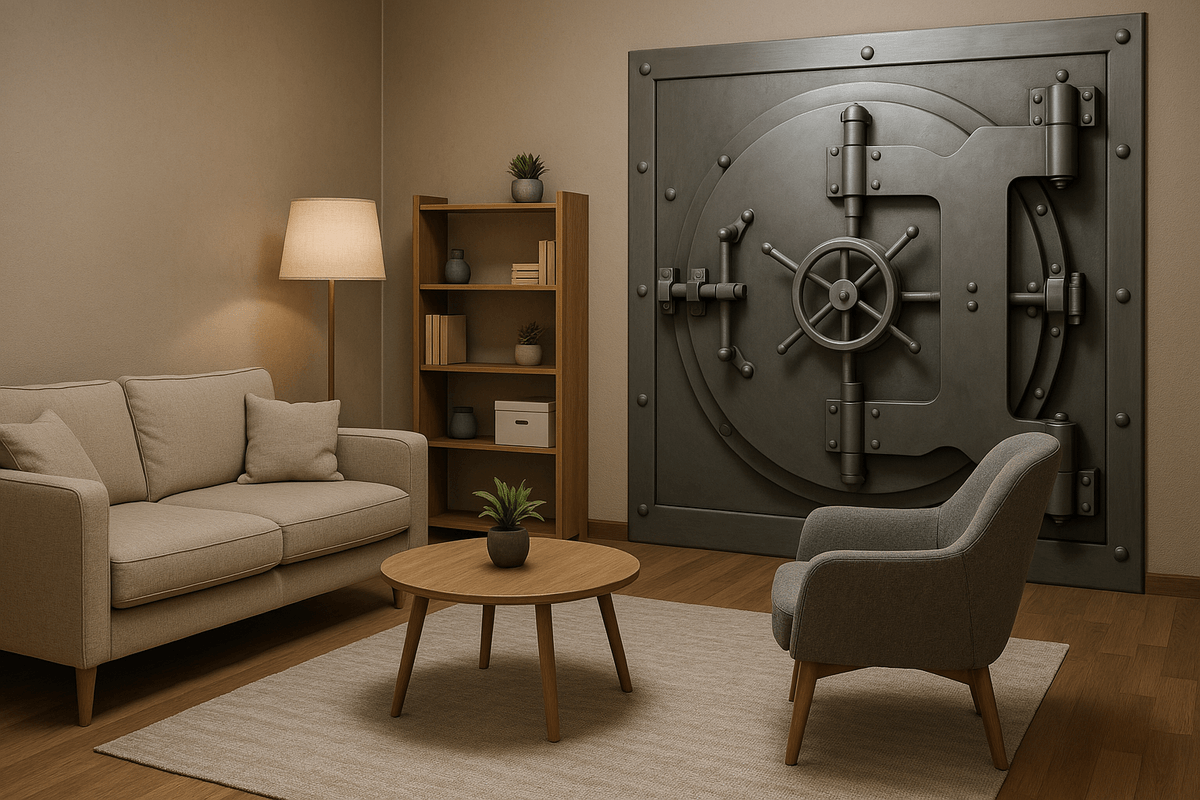
    A modern living room is styled with warm, neutral tones and cozy furnishings, yet features an unexpected architectural element—a large, industrial vault door embedded in the wall. The room includes a beige upholstered sofa, a gray armchair, and a wooden coffee table topped with a small potted plant. A floor lamp stands beside the sofa, casting soft ambient light, while a wooden bookshelf filled with books and decorative items adds texture and personality to the space. The vault door is metallic, circular, and imposing, with visible bolts and a central locking mechanism, sharply contrasting with the domestic comfort of the room. Its presence introduces a surreal or symbolic layer, suggesting themes of hidden value, protection, or psychological depth within a home environment. The overall composition blends security and serenity, creating a visually arresting and thought-provoking interior

    Confidentiality & Trust in Counselling

    In counselling, trust is built gradually over time. Counsellors often spend a considerable amount of time exploring confidentiality at the beginning of the process to reassure clients that whatever is shared remains protected.

    A professional who shares information about you casually — even without using names — misunderstands what confidentiality truly means. From both a moral and legal standpoint, this kind of disclosure breaks your confidence unnecessarily.

    Confidentiality means that what is shared stays within the counselling relationship. It is a promise of privacy, respect, and safety that allows you to speak freely and feel secure in the knowledge that your words are held in trust.

    When Confidentiality May Need Extending

    There are a few instances when confidentiality must be extended, and in most cases, this is due to legal obligations or to protect you or someone else if there is any form of immediate risk. Exceptions include:

    1. If you or someone else is at immediate risk of harm
    2. If anything disclosed falls within the scope of the Children Act
    3. If anything shared is considered a serious crime—this may include money laundering, terrorism, drug trafficking, or serious driving offences

    Confidentiality & Counselling Supervision

    In addition to legal exceptions, counsellors may also discuss aspects of their work with a counselling supervisor. A counselling supervisor is another qualified professional whom counsellors meet with regularly to reflect on how they are doing in relation to their work. To describe it simply — supervision is like counselling for counsellors, focused on professional growth and ethical practice.

    This process is less about the client’s personal content and more about the counsellor’s emotional responses and reflections on their work. In these conversations, any information that could personally identify a client is excluded. When necessary, pseudonyms are used to protect the client’s identity and maintain confidentiality.

    Return To Contents
  • Counsellor Do's & Dont's

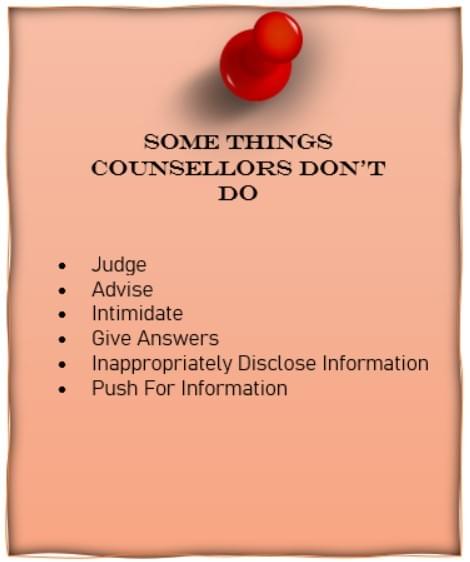
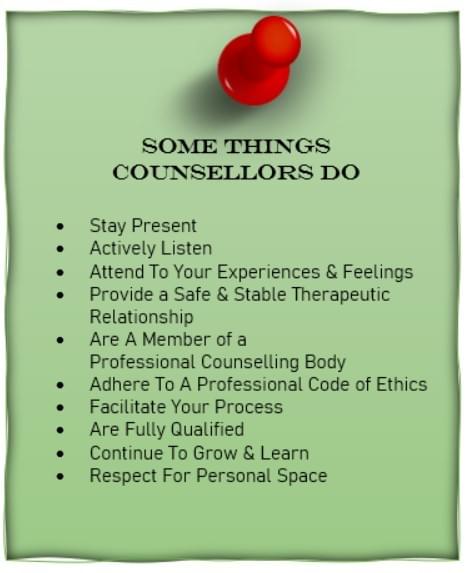
    Two pinned notes are displayed side by side, offering a clear visual comparison of counselor conduct. The left note is peach-colored and titled "SOME THINGS COUNSELLORS DON'T DO." It lists six behaviors that ethical counselors avoid: judging, advising, intimidating, giving answers, inappropriately disclosing information, and pushing for information. The right note is green and titled "SOME THINGS COUNSELLORS DO." It outlines ten affirming and professional practices, including staying present, actively listening, attending to clients' experiences and feelings, providing a safe and stable therapeutic relationship, being a member of a professional counselling body, adhering to a professional code of ethics, facilitating the client’s process, being fully qualified, continuing to grow and learn, and respecting personal space. The handwritten-style text and color contrast create an approachable, educational tone, making the image suitable for psychoeducational settings or professional training. The layout emphasizes ethical boundaries and supportive practices, reinforcing the values of trust, safety, and professionalism in therapeutic work
    Two pinned notes are displayed side by side, offering a clear visual comparison of counselor conduct. The left note is peach-colored and titled "SOME THINGS COUNSELLORS DON'T DO." It lists six behaviors that ethical counselors avoid: judging, advising, intimidating, giving answers, inappropriately disclosing information, and pushing for information. The right note is green and titled "SOME THINGS COUNSELLORS DO." It outlines ten affirming and professional practices, including staying present, actively listening, attending to clients' experiences and feelings, providing a safe and stable therapeutic relationship, being a member of a professional counselling body, adhering to a professional code of ethics, facilitating the client’s process, being fully qualified, continuing to grow and learn, and respecting personal space. The handwritten-style text and color contrast create an approachable, educational tone, making the image suitable for psychoeducational settings or professional training. The layout emphasizes ethical boundaries and supportive practices, reinforcing the values of trust, safety, and professionalism in therapeutic work

    kill switch align

    A circular green button featuring a white power symbol at its center. The symbol consists of a vertical line intersecting the top of a broken circle—an internationally recognized icon for powering on or off electronic devices. The background is a gradient of dark purple, which contrasts sharply with the bright green button, making it visually prominent. The design is sleek and modern, evoking themes of activation, control, and digital readiness. It may represent user interface elements, tech branding, or symbolic prompts for engagement and decision-making
  • WCSS Is growing with you!

    Articles | Updates | Offers | Gift Chance | Resources

    Need privacy & protection to feel safe enough to sign up?

    DuckDuckGo Email Protection

    (Free, Secure & Trusted)

    DDG Privacy Policy

  • Goal Setting

    Goals are often seen as an important part of the counselling process. Having a specific goal — or even a general sense of direction — at the start of therapy can help shape the journey and give you something to work toward.

    Much of the personal growth that emerges in counselling happens both within the sessions and in the spaces between them. The goals you set can become part of this wider process, supporting change, reflection, and movement in your everyday life.

    A close-up portrait of a person with curly hair set against a solid blue background. The individual’s face is partially obscured on the left side by a large leaf featuring a vivid green and white vein pattern, adding an organic, textural contrast. The person wears bold, colorful eye makeup—green and red tones blended across the eyelids—creating a striking visual focal point. Their skin is shown with natural texture, including visible pores and blemishes, emphasizing authenticity and realism. The composition balances vibrant color, natural imperfection, and botanical elements, evoking themes of identity, self-expression, and the interplay between human and nature

    You don’t need to arrive with a clearly defined goal to benefit from counselling. Many people come simply to explore what matters most to them, while others prefer to reflect on their experiences without setting specific objectives. Both approaches are entirely valid and can lead to meaningful insight and progress.

    Whether you’re working toward something specific or simply seeking space to think and feel more freely, sessions are there to support that process — at your pace. There’s no rush or pressure; counselling unfolds naturally as trust and understanding grow.

    Return To Contents
  • New To Counselling?

    Beginning therapy can be a unique experience for each individual, and it's important to recognise that people attending for the first time may feel apprehensive or anxious. Counsellors understand that taking the step to seek counselling can be challenging, so it is about making the process as warm, welcoming and comfortable as possible.

    A solitary figure stands on a deserted road, captured from a dramatic low-angle perspective that emphasizes the bold yellow centerline stretching toward the horizon. The person is dressed in dark clothing and faces away from the camera, gazing into the distance. Leafless trees line both sides of the road, suggesting a late autumn or winter setting. Above, the sky is filled with thick, overcast clouds that cast a moody, contemplative atmosphere across the scene. The composition uses strong leading lines and stark contrasts to evoke themes of solitude, introspection, and journey—both literal and emotional. The image’s visual tension between the grounded road and expansive sky adds depth and narrative potential

    Once you've found a counsellor you feel comfortable working with, the next step is to reach out to them. Counsellors typically list their preferred contact methods in the contact section of their website.

    A good starting point is to introduce yourself and share what has led you to seek counselling. This helps the counsellor understand your needs and determine how they can best support you.

    Your initial message is also an excellent opportunity to ask any questions you may have about the counselling process. If both you and the counsellor agree to proceed with a first session, arrangements will be made for an initial meeting, often referred to as a "welcome meeting." The first official counselling session usually follows this welcome meeting.

    After scheduling the welcome meeting, the counsellor will likely send additional information via email or message, including practical details such as their address if it's a face -to- face session, or a video link for online sessions

    The First Session

    The first counselling session typically follows a similar format to the welcome meeting and lasts up to an hour. During this time, you are more than welcome to talk about anything that you want. This is your opportunity to share your thoughts, feelings, and concerns in a supportive and non-judgmental environment.

    Here are some topics that might be covered during your first counselling session:

    • Introduction to the counselling space
    • Exploring confidentiality
    • Discussing what has brought you to seek counselling
    • Identifying your goals
    • Understanding your expectations
    • Addressing any special arrangements or adjustments
    Return To Contents

    kill switch align

    A circular green button featuring a white power symbol at its center. The symbol consists of a vertical line intersecting the top of a broken circle—an internationally recognized icon for powering on or off electronic devices. The background is a gradient of dark purple, which contrasts sharply with the bright green button, making it visually prominent. The design is sleek and modern, evoking themes of activation, control, and digital readiness. It may represent user interface elements, tech branding, or symbolic prompts for engagement and decision-making
  • FAQs

    How Do I Know If I Need Counselling?

    How Do I Start Counselling Sessions?

    How Many Sessions Will I Need?

    Can I Have More Than One Session Per Week?

    Are Sessions Confidential?

    Do My Parents Have To Know That I'm Having Counselling

    Why Is a Session 50 Minutes?

    Can Counsellors Write Notes Like Doctors Do?

    How Impactful is One Counselling Session Per Week?

    Can I Have 2 Forms of Counselling at The Same Time?

    Are Counsellors and Therapists The Same Thing?

    Does My Doctor Need To Be Informed About Me Having Counselling Sessions?

    What is Online Counselling?

    Can I Have More Than An Hour ?

    Do Counsellors Need To Be Qualified and How Qualified Are They?

    Can I Refer Someone To Counselling If I Am Worried About Them?

    Can I Have A Break From Counselling?

  • See Also:

    Counselling | Online Counselling | Counselling Supervision | About | Contact

  • "The curious paradox is that when I accept myself just as I am, then I can change."

    Dr Carl R Rogers -

    Person Centred Psychologist

    A black-and-white photograph of Carl Rogers, the influential humanistic psychologist, captured in a candid moment of expression. He wears glasses and a light-colored button-up shirt, seated indoors with curtains visible in the background. His hands are raised mid-gesture, suggesting he is engaged in conversation, explanation, or teaching. The grayscale tones emphasize the texture of his skin and the thoughtful intensity of his posture. The image conveys a sense of warmth, wisdom, and attentiveness—qualities central to Rogers’ person-centered approach. The composition highlights his role as a communicator and educator, making the image suitable for contexts related to psychology, counselling, or historical reflection on therapeutic practice
Purple square logo featuring a white circular brushstroke emblem surrounding the word ‘WRIGHT’ in bold uppercase lettering, with three small white dots above it and the text Counselling & Supervision Service’ below.

Contact

GMaps

Email

VCard

Service Info

Contact

Pricing

Policies

Business Statement

Log In

Testimonials

Services

Counselling
Online Counselling
Supervision
Group Supervision

Wrightings™

Site Glossary

Affiliations

Strive Therapy

Carino Counselling

10 Thousand Hours

Subscribe to Our Newsletter

Benjamin J Wright

Clinical Therapeutic Counselllor | Counselling Supervisor

Dip.co.MNCPS (Acc.), BSc PG dip

Clinical Therapeutic Counselling Since 2013

Accredited Registrant with the National Counselling & Psychotherapy Society (NCPS)

NCPS Registration No. NCS22-00211

Wright Counselling & Supervision Service ™

Copyright© 2017-2026

    Home
    UK Police
    Email
    Close Site
Cookie Use
We use cookies to ensure a smooth browsing experience. By continuing we assume you accept the use of cookies.
Learn More